French grammar · A1 · Lesson 3
Avoir and il y a
Avoir means “to have”: j’ai, tu as, il a, nous avons, vous avez, ils ont. Il y a is a fixed phrase meaning both “there is” and “there are”, and it never changes for plural: il y a un orage, il y a des messages.
Last updated:
How does it work?
Avoir, “to have”, is the other great irregular verb, and together with être it holds up half the language. Six forms, learnt once and for all:
| avoir | ||
|---|---|---|
| j’ | ai | I have |
| tu | as | you have (one friend) |
| il / elle / on | a | he / she / it has, one has |
| nous | avons | we have |
| vous | avez | you have (polite, or several people) |
| ils / elles | ont | they have |
Je loses its e in front of a vowel, so it is always j’ai, never ✗ je ai. Say it as one word: “zhay”.
The trap: ont and sont. Ils ont (they have) and ils sont (they are) differ by one sound. In ils‿ont the silent s of ils wakes up and joins the vowel, giving a buzzing z: “eel-zon”. In ils sont you hear a hissing s: “eel-son”. Buzz for having, hiss for being. The same linking z appears in nous‿avons and vous‿avez.
Il y a is a fixed phrase meaning “there is” or “there are”. The il is an empty “it”, nobody in particular, and y means “there”. Literally: “it there has”. Because nobody is the subject, it never changes for plural:
| one thing | several things |
|---|---|
| Il y a un orage. | Il y a des messages. |
| There is a storm. | There are messages. |
So keep the two apart: il a un message is “he has a message”, a person owning something; il y a un message is “there is a message”, something simply existing somewhere.
What does it look like in the story?
These sentences come from lesson 3, “A message from the sky”, where the narrator is crossing the Atlantic on the liner Provence with Arsène Lupin hidden among the passengers.
| French | English |
|---|---|
| J’ai un message de deux amis de Paris. | I have a message from two friends in Paris. |
| Les autres passagers ont des messages aussi. | The other passengers have messages too. |
| Dans la cabine, il y a un employé et une machine. | In the cabin there is an operator and a machine. |
Try it: J’ai and ont are forms of the same verb. Which one? And in il y a un employé, who is il? Is anybody actually “having” anything?
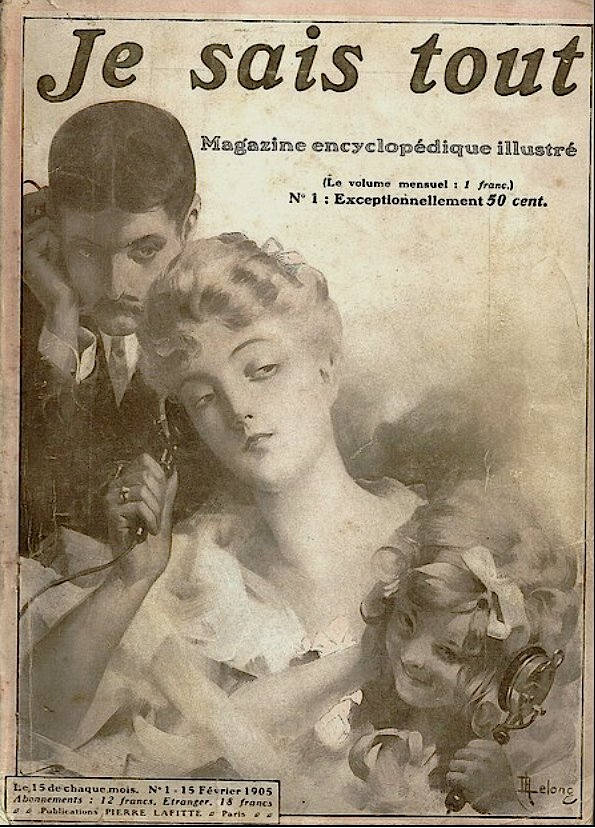
« Le télégraphe sans fil! appel d'un autre univers d'où l'on recevrait des nouvelles de la façon la plus mystérieuse qui soit! »
The wireless telegraph! A call from another universe, from which news would come to us in the most mysterious way imaginable! Maurice Leblanc, L’Arrestation d’Arsène Lupin (1905).
How is it different from English?
English builds “there is / there are” with the verb to be, and changes it for plural. French builds it with avoir and never changes it: il y a for one storm and for a hundred messages. French also uses avoir where English uses “be” in other places: j’ai trente ans, “I am thirty”, literally “I have thirty years”.
What mistake do English speakers make?
English speakers translate “there is” word by word: ✗ Il est un employé dans la cabine. That sounds like “he is an operator”. Say ✓ Il y a un employé dans la cabine. And do not make it plural: ✗ Il y ont des messages, ✓ Il y a des messages.
Where can I practise it?
- Lesson 3: A message from the sky: the story, the rule and interactive exercises, free.
- Review 1: lessons 1 to 5: this point again, in a summary table with the other lessons of the block.
- The A1 glossary: every word of the course, French to English.
← Adjective agreement, les and des · Where adjectives go: colours and the body →